By: Jorge Avila
I want to share a very interesting saint with you, to say the least. He goes by the name of St. Fiacre. St. Fiacre was the son of an Irish king and, at an early age, was raised to live a religious life. He was entrusted to a man known as St. Conan, another Irish saint, who raised Fiacre until he was old enough to go out on his own and live as a hermit, as Fiacre wanted. Fiacre moved to Kilkenny, Ireland, and because of his extensive knowledge of herbs and homeopathic remedies, many people came to visit him. But with so many people coming, it was hard to keep up this hermetic lifestyle, so he decided to settle in Meaux, France; the bishop of Meaux, St. Faro, wanting intellectual companionship and knowing Irish priests were quite learned, granted Fiacre land to establish his hermitage.
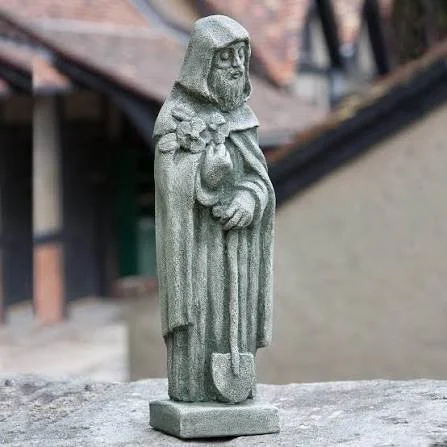
Garden statue of St. Fiacre.
Yes, he was alone for a time, but more and more people came to see him; he took that as a sign from God and decided to build a small chapel, a small hospice, and a remote dwelling for himself. As amazing as it was helping all these people, soon there wasn’t enough land to accommodate everyone; because of this, he went to St. Faro and asked for more land, and he agreed, but it was under the condition that he could have as much land as he wanted if he could till as much land as he could between sunrise and sunset. Fiacre was excited with the proposition and rushed back to his abode to begin tilling in a prayer-filled frenzy with his cane. During this time, a woman, Becnaude, saw what Fiacre was doing and was convinced He was possessed because, as he tilled, he toppled large, pretty trees. Becnaude went to tell Faro, and he knew she was describing Fiacre. Becnaude went back to Fiacre, screaming like Fiacre, trying to tell him he was in trouble. Still, Fiacre was deeply focused, daydreaming about all the wonderful things he could do with this land in God's name. Something funny, though, is that, lost so deeply in thought, he had sat his skinny, Irish hermit self on a granite rock, and it softened like wax, leaving an imprint of his posterior. When Faro came to check on Fiacre’s progress, he saw the Fiacre ’sion in the stone and said: “One can doubt everything except for a Scot’s rear!” Then Faro told Fiacre what Becnaude had told Fiacre, and he became quite irate, so much so that he held quite a mean grudge to the point that he banished ALL women from his monastery; if any dared come regardless of his rules, they risked a severe thrashing from him.
St. Fiacre is most definitely quite a character and an interesting man. Yet even though he held such a prejudice against women and a heavy grudge, he still deserves our respect and devotion because of how much he did in the name of God. He’s a perfect example of someone who is still undoubtedly human, who was clearly imperfect, yet still led a life entirely devoted to and focused on God; a perfect example of someone whose story we can see and from whom we can grow.